Jev Is Not a Paradigm Shift. It’s ust a Fast Classifier.
Jev Doesn't Fix LLM Evaluation. It Just Makes It Faster
I called Jev a glorified, high-speed classifier.
Then I did the thing controversial posts usually skip:
I tried to prove myself wrong.
I went through TypeSafe’s launch material, LangChain’s harness and Jev-as-a-Judge experiments, Vercel’s implementation guidance, TypeSafe’s documented failure modes, the launch-day Hacker News arguments, accessible practitioner analysis, independent Jev benchmarks, an API-only calibration audit, and the first Jev research paper I could find with blinded human judgments.
My conclusion got narrower.
It did not get softer.
Jev is a genuinely useful decision model. It may be one of the better new primitives for putting semantic judgment inside software. But the evidence available today does not justify treating it as a new paradigm for reliable AI evaluation.
Jev removes several problems that come from using generative LLMs as judges. It does not remove the harder epistemic problems underneath evaluation: incomplete evidence, incomplete answer spaces, bad rubrics, semantic error, distribution shift, and the difference between probability and truth.
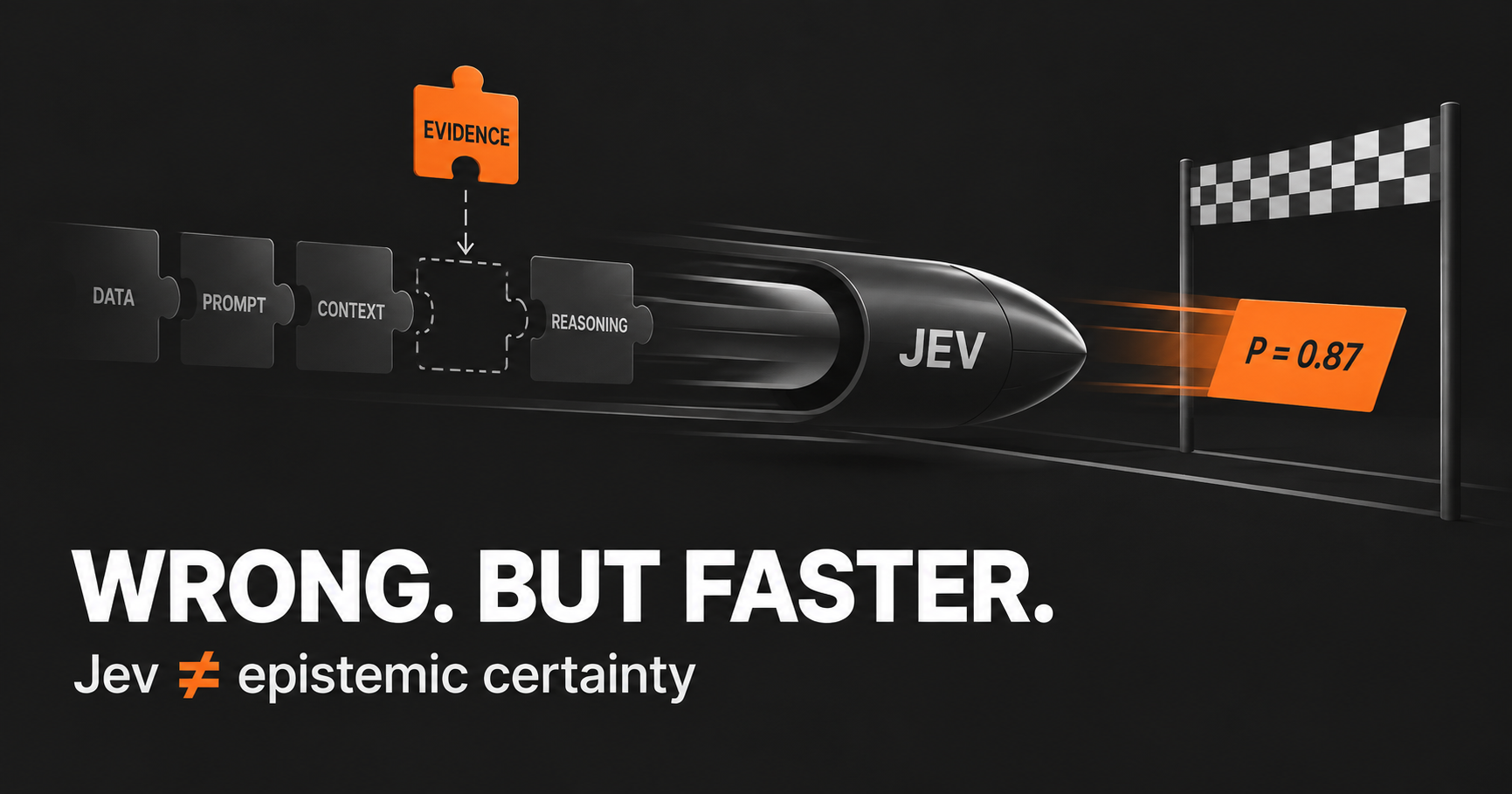
Jev can make a wrong decision faster, cheaper, and with a perfectly valid type.
That is not an argument against Jev.
It is an argument against confusing better execution with better knowledge.

First, I need to correct one word from my own hot take
I wrote that Jev runs into the exact same evaluation traps as LLM judges.
After digging deeper, “exact” is too broad.
That matters.
LLM-as-a-judge has failure modes tied specifically to generative models. The classic MT-Bench work documented position, verbosity, self-enhancement, and reasoning biases in LLM judges. Jev’s bounded, non-generative interface changes that failure surface.
An independent Jev calibration audit gives a concrete example. Across 400 binary items, reversing the option order changed probabilities by only 0.005 on average and caused zero argmax flips. This indicates that, for that task, a common artifact found in LLM judges might be largely absent.
So I am narrowing the statement:
Jev does not inherit every LLM-judge failure. It inherits the fundamental evaluation failures that exist before generation even starts.
That is the claim I am willing to defend.
And I think it is more damaging to the hype than the original sentence.
Jev is a classifier. That is not an insult.
A surprising amount of the Jev debate gets stuck on terminology.
TypeSafe calls Jev the first System One Model: state goes in, typed probabilistic decisions come out. It supports three main decision shapes: Choice, Score, and Noul. It does not generate arbitrary prose.
The category name is new.
The task family is not.
Zero-shot text classification was already established enough to have a dedicated EMNLP benchmark paper in 2019. Classification itself is obviously much older.
And the “Jev is basically a zero-shot classifier” interpretation is not merely something critics invented.
On the Hacker News launch thread, one commenter described Jev as a zero-shot classifier that accepts raw text and classifies it at frontier-LLM-like quality.
TypeSafe CEO Diogo Almeida replied:
exactly right!
Another commenter described it as something closer to a Large Classification Model than a Large Language Model.
Almeida’s response:
very accurate!
That does not make Jev trivial.
It makes the interesting question much more precise.
The innovation is not classification exists now.
The interesting combination is:
Natural-language state
        ↓
Runtime-defined semantic questions
        ↓
Bounded answer spaces
        ↓
Parallel typed decisions
        ↓
Probability distributions
        ↓
Application policy
No per-task fine-tuning.
No autoregressive paragraph just to obtain billing.
No JSON repair loop.
No invented enum value.
Several questions can share one state and be evaluated in parallel.
And TypeSafe says Jev is trained using Reinforcement Learning for Calibrated Decisions (RLCD) rather than for human-preferred prose.
That package is interesting.
Potentially very important.
But an old task with a much better operating point is still not automatically a new epistemology.
What Jev actually improves is substantial
I do not want to straw-man the product.
TypeSafe’s launch benchmarks report Jev at up to 193.6× faster and 444.6× cheaper than frontier LLM workflows on selected System One tasks. Its listed input price is $0.042 per million tokens, with output effectively unmetered because there is no free-form generation.
Those are vendor-reported numbers, not universal performance guarantees.
Independent testing has found smaller—but still meaningful—advantages. One 791-decision benchmark across intent routing and prompt-injection detection measured Jev at roughly 2.0–3.6× faster at the median and 4.7–7.5× cheaper than the cheaper LLM baselines in that test. GPT-5.6 Terra still beat Jev by about five accuracy points on the 77-way intent task.
That is a much less viral result.
It is also a perfectly good engineering result.
The same study found a Jev-to-Terra confidence-gated cascade could match Terra-only accuracy at roughly 26–28% of Terra’s cost.
That is where I think Jev becomes genuinely compelling.
Not as:
LLMs were wrong. System One won.
But as:
Stop paying a general-purpose generator every time your software needs a bounded semantic decision.
That is a useful architectural correction.
The headline benchmark is not an accuracy crown
The launch numbers need another qualification.
TypeSafe’s four-workflow evaluation covers production-shaped tasks such as security incidents, agent-trace observability, invoice processing, and customer service.
Across those workflows, Jev reportedly lands around 67.8% on the vendor’s evaluation measure. GPT-5.6 Terra is around 67.9%, while stronger frontier comparators reach roughly 73–74%.
But the important word is measure.
The reference answers were constructed from frontier-model judgments rather than independent human ground truth.
So this is better interpreted as agreement with a model-generated reference, not proof of objective correctness.
That distinction is not pedantry.
If the debate is about replacing LLM judges because LLM judges are unreliable, using LLM judgments as the reference for the replacement should immediately make us careful about what “accuracy” means.
Fast? Measured.
Cheap? Measured.
Schema-valid? Architecturally enforced.
Correct about the world? That requires a different experiment.

The real limitation appears before Jev ever runs
Here is the hidden variable I think the hype keeps skipping:
Is the answer actually identifiable from the supplied evidence?
Ask:
Why did customer churn increase in July?
Give Jev this state:
Prices increased by 8% in July.
Can price be a plausible hypothesis? Absolutely.
Can Jev infer that price increases often affect churn? Possibly.
Can it know from that evidence that the price increase caused the July churn increase? No.
Maybe a competitor launched a migration campaign.
Maybe the product shipped a severe regression.
Maybe support response times doubled.
Maybe churn increased in a cohort whose prices never changed.
Maybe several causes interacted.
The same problem appears with:
Why did sales drop last month?
State:
Website traffic dropped 10%.
Lower traffic may explain part of the decline.
But without conversion rate, inventory, pricing, campaigns, checkout failures, product mix, and seasonality, the causal story is underdetermined.
Or:
Why is this customer unhappy?
State:
They contacted support three times.
That is a signal.
It is not the reason.
This is not a weakness unique to Jev.
That is exactly my point.
It is a boundary of inference.
If a competent human expert receives exactly the same evidence and still cannot determine the answer, model speed cannot make the missing fact appear.
Vercel’s own Jev guidance effectively says the same thing. Before relying on a threshold, it recommends checking whether Jev has enough current information to make the decision. Its evaluation guidance explicitly says to include cases where information required for routing is missing.
That is not an implementation footnote.
That is the boundary between decision and knowledge.
We now have an experiment that looks almost exactly like my argument
My churn example is hypothetical.
A recent independent Jev audit tested something much cleaner.
The audit used KoBBQ, a benchmark deliberately constructed with ambiguous examples where the supplied context does not contain enough information to identify the answer. For those cases, the correct answer is explicitly unknown.
The researchers tested 300 ambiguous and 300 disambiguated items.
With the unknown option available, Jev performed extremely well on the ambiguous set:
| Condition | Accuracy | Mean confidence | Calibration error |
|---|---|---|---|
| Unknown available | 95.0% | 0.927 | 0.023 |
| Unknown removed | 0.0% | 0.793 | 0.793 |
Read that second row again.
Same model.
Same unanswerable evidence.
Remove the schema option that lets the system represent “this cannot be determined” and accuracy collapses to zero.
The model does not magically become epistemically humble.
It chooses among the remaining options.
Worse, in that experiment it selected the stereotyped answer on 79% of the ambiguous cases while maintaining about 0.79 mean confidence.
This is an independent API-level audit, not a peer-reviewed Jev paper, so I would not universalize the result.
But it demonstrates the architectural point beautifully:
Abstention is not created by probability. It has to exist in the decision space.
If your ontology cannot represent ignorance, your beautifully typed decision system may force uncertainty into the wrong class.
That is not solved by being non-autoregressive.
Typed ≠ true
This brings me to the “Jev can’t hallucinate” claim.
TypeSafe uses that language in the launch post.
There is a defensible interpretation.
Suppose your Choice permits:
billing
engineering
sales
Jev is not going to return:
quantum_archaeology
It also does not need to write a paragraph, serialize JSON, close braces correctly, or resist the temptation to add a fourth category your code never defined.
That eliminates a real class of structural output failure.
Good.
But now imagine the correct route is engineering and Jev confidently returns billing.
The type system is happy.
Reality is not.
So I would separate two claims:
| Claim | Jev |
|---|---|
| “Can the model emit an invalid answer shape?” | Strongly constrained by design |
| “Can the model select a valid but wrong answer?” | Yes |
Vercel makes this distinction explicitly: valid output format does not establish that a classification is semantically correct.
TypeSafe’s own documentation also publishes a “jaggedness” list for Jev 1.13. It includes literal interpretation, unreliable arithmetic and counting, weak date comparison, reduced reliability under indirection, context rot from irrelevant state, sensitivity to adversarial content, contradictory criteria, and even inconsistencies across logically related question formulations.
That is refreshingly candid.
It also makes “zero hallucination” a terrible synonym for “zero error.”
Schema-valid ≠ world-valid.
Calibrated ≠ correct
Calibration is probably Jev’s most interesting claim.
It is also where people can accidentally turn a statistical property into a magical one.
A well-calibrated model that says 0.8 across a population of comparable predictions should be correct about 80% of those predictions.
That does not mean this particular 0.8 answer is true.
This is not Jev-specific criticism. Calibration has been studied for years. Guo et al.’s ICML 2017 work formalized the practical problem of neural-network confidence not matching empirical correctness. Ovadia et al. later showed at NeurIPS 2019 that uncertainty quality can deteriorate under dataset shift.
So even if RLCD materially improves calibration—and I hope it does—the next question is:
Calibrated where?
On which domains?
Which language?
Which question formulation?
Which model version?
Which distribution?
A new September 2026 preprint using Jev on police crash narratives makes this especially interesting. The study screened 499,500 narratives, coded 195,857, and compared against 2,416 blinded human judgments. Jev achieved an F1 of 0.908 against those human labels.
That is serious evidence compared with launch-day demos.
And the paper still reports that calibration varied by model rather than by paradigm. Recalibration on the labeled data reduced calibration error by a factor of 3.3.
Read the implication carefully.
The paper is not saying Jev failed.
It is saying something more useful:
being a “System One Model” does not exempt a model from empirical calibration on the distribution where you intend to trust it.
Vercel’s production guidance reaches the same operational conclusion: select thresholds using labeled examples from your own application and revisit them when traffic or categories change.
In other words:
Calibration is something you measure, not something you inherit from a product category.
And no, Jev does not have every LLM-judge weakness
This is where I want the argument to remain intellectually honest.
Jev’s constraints are not cosmetic.
The independent calibration audit found option-order stability that looks materially better than a well-documented LLM-judge weakness.
It also found that batching questions worked impressively well: asking 16 questions instead of one moved confidence by only 0.008 on average, flipped answers on about 0.4% of items, and added only around 14 ms median latency in that experiment.
Those are good results.
LangChain’s Jev-as-a-Judge test is also legitimately interesting.
They froze five weather-agent runs and asked Jev, GPT-5.6 Luna, GPT-5.6 Terra, and Claude Sonnet 4.6 to judge them 100 times each.
On the binary pass/fail signal, Jev matched one human reviewer on all 500 repeated judgments.
Its continuous quality-score variance was dramatically lower: LangChain reports LLM-judge variance from 92× to 913× higher than Jev’s depending on the comparator.
Jev averaged about 0.44 seconds and $0.00035 per call.
Those are excellent numbers.
But five unique agent runs are still five unique agent runs.
Repeating them 100 times is useful for measuring repeatability.
It does not magically turn five examples into 500 independent tests of general accuracy.
LangChain says this itself.
A judge can be consistent and wrong.
A tiny test can be promising and still be tiny.
Both statements can be true at once.
So what evaluation traps actually survive?
This is the distinction I wish more Jev discussion made.
| Failure mode | LLM judge | Jev |
|---|---|---|
| Free-form schema failure | Possible | Strongly reduced/eliminated |
| Autoregressive latency | Yes | Removed from output path |
| Generation variance | Yes | Strong early evidence of reduction |
| Option-order bias | Documented | Absent in one independent Jev test |
| Insufficient evidence | Yes | Yes |
| Incomplete answer space | Yes | Yes — potentially catastrophic |
| Bad rubric / ambiguous criterion | Yes | Yes |
| Semantic misclassification | Yes | Yes |
| Bad reference labels | Yes | Yes |
| Distribution shift | Yes | Yes |
| Calibration transfer | Must validate | Must validate |
This is why my claim is not “Jev and LLM judges are identical.”
They obviously are not.
My claim is that the most important evaluation problems were never all caused by text generation in the first place.
Jev removes the problems created by asking a text generator to behave like a classifier.
It cannot remove the problems created by asking a classifier to judge a world it cannot fully observe.
“Paradigm shift” is doing too much work
Maybe I am being overly strict about the phrase.
Software people use “paradigm shift” for anything released on a Tuesday with a benchmark chart.
And Jev does introduce a compelling engineering primitive.
I can easily imagine architectures where it becomes the default semantic decision layer:
Deterministic fact?
        ↓
      Code

Bounded semantic judgment?
        ↓
      Jev

Need current missing information?
        ↓
 Retrieval / tools

Need open-ended synthesis?
        ↓
      LLM

High-impact unresolved ambiguity?
        ↓
     Human
That is a better architecture than firing a frontier LLM at every fuzzy if statement.
But that is specialization.
We have done this throughout the history of software engineering.
General systems create possibilities.
Specialized systems make specific workloads cheaper, faster, and easier to reason about.
Sometimes that changes an industry.
It does not mean the underlying problem disappeared.
Jev’s strongest case is not that classification became new.
It is that general-purpose, zero-shot semantic classification may have become cheap and composable enough to use everywhere.
That is a much more defensible—and honestly more interesting—claim.
What would change my mind?
If we want to establish Jev as a fundamentally new evaluation paradigm rather than an excellent decision primitive, I want benchmarks designed around the hard boundary.
Not more clean classification examples.
I want deliberately missing facts.
Incomplete answer spaces.
Contradictory evidence.
Misleading correlations.
Out-of-distribution traffic.
Rubrics whose labels overlap.
Cases where
unknownis objectively correct.Cases where the
referencelabel itself is uncertain.
Then measure:
accuracy
+ calibration
+ abstention quality
+ false certainty
+ selective risk
+ robustness under distribution shift
+ sensitivity to question/schema design
The funny part is that the early independent evidence is already moving in exactly this direction.
And some of it looks good for Jev.
That is what research is supposed to do.
Not prove the launch slogan.
Find the boundary.
Jev is good. The hype is still wrong.
After trying to attack my own argument, I am more positive about Jev than when I started.
I am also less convinced by the “new paradigm” framing.
Jev appears to solve a real and expensive systems problem:
we have been using generative models for decisions that never needed generation.
That matters.
A lot.
But Jev is not a new theory of truth.
It is not a substitute for evidence.
A calibrated probability is not ground truth.
A valid enum is not a valid conclusion.
A fast judge is not an omniscient judge.
And if your system does not give the model a legitimate way to say “I cannot know this from what you gave me,” the model may still choose something.
Only now it can do it in 200 milliseconds.
Jev does not make missing evidence disappear. It makes bounded judgment dramatically cheaper. Confusing those two things is the real evaluation bug.
Sources & evidence quality
Primary / platform sources
TypeSafe AI — vendor launch: Introducing System One Models & Jev
TypeSafe API: TypeSafe API documentation
TypeSafe — documented model limitations: Jev 1.13 jaggedness
TypeSafe — vendor evaluation dashboard: Jev evaluations
LangChain — implementation: Building a Harness with Jev
LangChain — small third-party experiment: Jev-as-a-Judge for Agent Evals
Vercel — implementation guidance: What is Jev?
Vercel — threshold guidance: How should you use Jev’s probabilities to set decision thresholds?
Vercel — workload selection: When should you use Jev instead of a chat model?
Evalgent — practitioner evaluation analysis: Jev for Voice Agent Evaluation
Manjeet Singh — practitioner analysis: Jev Model: Jev-as-a-Judge for Agent Evals
Independent / reproducible Jev evidence
Independent API calibration audit: jev-calibration-audit
Independent 791-decision benchmark: Jev vs GPT and Claude
Research preprint: Calibrated Decisions at Scale: Converting Police Crash Narratives into Probabilistic Crash Variables with a System One Model (Jev)
Hacker News launch discussion: Introducing System One Models and Jev
TechCrunch launch reporting: A new kind of AI model from a ChatGPT inventor is thrilling developers
Relevant research background
Peer-reviewed, EMNLP 2019: Benchmarking Zero-shot Text Classification
Peer-reviewed, ICML 2017: On Calibration of Modern Neural Networks
Peer-reviewed, NeurIPS 2019: Can You Trust Your Model’s Uncertainty?
NeurIPS 2023: Judging LLM-as-a-Judge with MT-Bench and Chatbot Arena